How Perplexity, ChatGPT, Google, and Copilot
Find and Cite Your Content
A practical guide to the crawlers, indexes, and content signals that shape AI search visibility - and what your business can actually do about them.

The Opening Answer
AI search is not just Google's old results page with a chatbot bolted on top. When someone asks Perplexity, ChatGPT, Google, or Copilot a question, the platform combines what its model already learned during training with live web searches, entity graph data, and real-time prompt context.
"There is no single 'AI ranking algorithm' to crack. Each answer engine finds, weighs, and cites sources differently depending on its architecture and user-agent rules. Your safest cross-platform play is simple: publish clear, well-structured content, back your claims with solid evidence, and keep your business details consistent across every directory and profile that matters."
Reality Checks Before You Optimise:
- Live search isn't behind every AI answer. Models rely heavily on pre-trained parametric memory before deciding to query the live web.
- Training data and a search index are separate systems. Blocking a training bot like
GPTBotdoesn't stopOAI-SearchBotfrom finding you for live answers. - Being indexed gets you in the door - it doesn't guarantee a citation. Indexation makes your page eligible; relevance and clarity win the spot.
- Ranking #1 in organic search doesn't automatically earn an AI citation. Generative engines pick passages that answer specific intent, not just domain authority.
- Schema helps machines understand your page, but it can't force a citation. Structured data gives context; it doesn't buy placement.
- A linked citation doesn't make every generated claim true. Hallucinations happen even when an engine links to a legitimate source.
How Answer Engines Look Up Information
Before chasing citations, it helps to know where an answer engine gets its information. In practice, it draws from two main layers:
Facts baked directly into the model during initial training. It's instant, but static - and it doesn't require a live visit to your site.
Fresh information pulled from live search indexes, crawlers, or connected databases during a prompt. This is the layer where your accessible web content comes into play.
A Practical View of How AI Search Builds an Answer
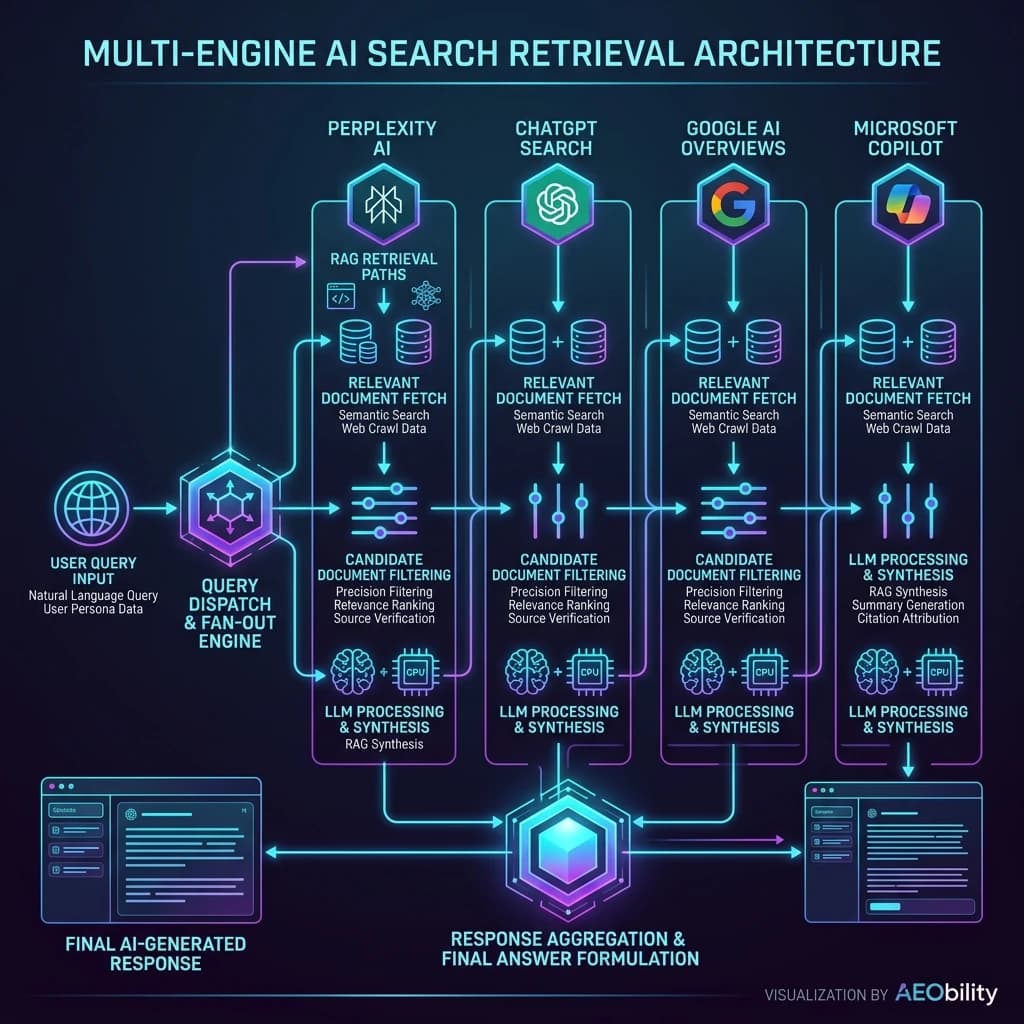
While production architectures vary between commercial providers, most search-augmented AI systems follow a multi-stage Information Retrieval (IR) pipeline:
The engine interprets intent, expands acronyms, and identifies core entities.
A single prompt often triggers multiple parallel queries targeting sub-topics.
The engine searches for relevant section chunks rather than judging whole pages in isolation.
Candidate passages are reranked for relevance, which is where positional bias in retrieval can impact which chunks get extracted.
The LLM synthesises the top-ranked context into a readable answer.
Generated claims are mapped back to URLs where supporting data was drawn.
Conceptual AI Retrieval & Query Fan-Out Pipeline
Architecture SchemaCore Technical IR Concepts Explained
Keyword-matching algorithms (e.g. BM25) that match exact tokens between query and document text.
Vector-embedding search that measures conceptual similarity using high-dimensional mathematical distance (e.g. cosine distance).
Combining lexical keyword precision with dense semantic vector retrieval to maximise recall and precision.
Deconstructing a single complex prompt into multiple parallel search queries targeting sub-topics and entity facts.
Common Misconceptions About AI Retrieval
Separating persistent industry myths from verifiable retrieval mechanics is essential for allocating digital marketing resources effectively.
| Common Misconception | Corrective Explanation |
|---|---|
| Every AI answer comes from live web retrieval. | Some answers rely mainly on model knowledge; search-enabled retrieval depends on the specific product, mode, user query, and context. |
| Training data and a search index are the same thing. | Training data influences stored parametric model knowledge, whereas search retrieval provides access to external, live web content. |
| Indexation guarantees an AI citation. | Indexation is generally a prerequisite eligibility condition, not a placement guarantee or citation assurance. |
| Ranking number one guarantees inclusion. | Traditional organic ranking supports discovery, but does not guarantee selection or citation in a generated AI answer. |
| Schema guarantees AI visibility. | Structured data aids machine interpretation when accurate, but cannot force retrieval; Gemini prioritises rendered inline HTML tables over raw unrendered schema. |
| A citation proves the answer is correct. | Generated answers can still contain hallucinations or inaccuracies even when citing legitimate supporting sources. |
| All answer engines use one algorithm. | Each platform (Perplexity, OpenAI, Google, Microsoft) operates distinct crawler controls, indexes, context windows, and retrieval mechanics. |
| ChatGPT, ChatGPT Search, and GPTBot are the same system. | OpenAI explicitly distinguishes OAI-SearchBot (live search), GPTBot (training crawler), and ChatGPT-User (live user prompt fetch). |
| Google requires special AI-only schema. | Google officially confirms AI Overviews (single-turn summaries) and AI Mode (conversational search) use standard Search Essentials eligibility requirements. |
| IndexNow guarantees instant Copilot visibility. | IndexNow accelerates change discovery, but Microsoft explicitly confirms it is not a ranking factor and guarantees neither indexation nor Copilot citation. |
| Longer pages are more likely to be cited. | Relevance, self-contained passage-level clarity (45-75 word chunks), inverted pyramid structure, and machine accessibility matter far more than total length. |
| A citation automatically produces traffic or conversions. | Visibility, citation placement, user click-through, trust, and conversion are separate stages in the user journey. |
Platform Breakdown: Controls, Patterns & Recommendations
Each AI answer engine operates within distinct crawler environments, index permissions, and user experience paradigms - and optimising for multi-turn conversational queries requires an integrated AI search marketing strategy rather than isolated page tweaks.
Perplexity Search
Direct Answer & Citation Engine
1. Documented Controls
- •Documents
PerplexityBot(indexing crawler) andPerplexity-User(live prompt agent). - •While
PerplexityBotrespectsrobots.txt, user-triggered fetches viaPerplexity-Usermay operate under different fetch rules. - •Crawler access is an eligibility prerequisite, not a placement or citation guarantee.
2. Observed Patterns
- •Direct answer-first introductory paragraphs are extracted cleanly.
- •Explicitly attributed evidence, empirical data, and rendered HTML
<table>elements support extraction. - •Clean structural markup helps locate specific factual data points.
3. Editorial Recommendations
- •Lead page sections with direct, standalone answers.
- •Attribute statistics, claims, and expert quotes explicitly.
- •Keep important content in accessible HTML text rather than client-only scripts.
ChatGPT Search
OpenAI Search & Grounding Architecture
1. Documented Controls
- •
OAI-SearchBotcontrols live ChatGPT Search inclusion. - •
GPTBotmanages offline model pre-training access. - •
ChatGPT-Userexecutes real-time user-initiated prompt fetches.
2. Observed Patterns
- •Descriptive H2/H3 headings improve passage extractability.
- •Q&A phrasing reflecting genuine user intent aids context matching.
- •Heavy JS hydration creates parsing risks for lightweight scrapers.
3. Editorial Recommendations
- •Ensure core content renders natively in server-rendered HTML.
- •Use meaningful heading structures (
<article>,<section>). - •Do not rely on FAQPage schema as a guaranteed shortcut.
Google AI Overviews & AI Mode
Google Search Generative Features
1. Documented Controls
- •Spans AI Overviews (single-turn SERP summaries) and AI Mode (conversational search).
- •Both rely on standard Google Search indexation; AI Mode executes deeper multi-turn query fan-out.
- •Google explicitly confirms there are no additional AI-specific technical requirements.
2. Observed Patterns
- •Gemini prioritises self-contained passage chunks (45-75 words) following an inverted pyramid format.
- •Rendered inline HTML
<table>elements and lists are extracted at higher rates than raw schema alone. - •Knowledge Graph entity accuracy and local intent signals support machine interpretation.
3. Editorial Recommendations
- •Structure content using an inverted pyramid format (Direct Answer → Data → Context).
- •Ensure rendered HTML tables accompany structured data implementations.
- •Track performance using Google Search Console Search Appearance AI Overviews filters.
Microsoft Copilot & Bing Experiences
Consumer Web & Enterprise Agent Ecosystem
1. Documented Controls
- •Copilot retrieves web content via Bing Search APIs (relying on Bingbot for prior indexation); Copilot does not crawl directly.
- •Product tiers span Consumer Web, Edge/Windows, M365 Graph, and Copilot Studio with distinct knowledge sources.
- •IndexNow accelerates discovery, but Microsoft explicitly confirms it is not a ranking factor.
2. Observed Patterns
- •Bing Webmaster Tools indexation correlates with consumer Copilot answers.
- •Bing Places listings and Merchant feeds support location/product signals, though direct Copilot influence varies by prompt context.
- •Retrieval behaviour varies significantly by Copilot product tier and enterprise policy.
3. Editorial Recommendations
- •Configure Bing Webmaster Tools & IndexNow protocol for rapid change notifications.
- •Maintain accurate Bing Places listings and product feed feeds.
- •Define the specific Copilot product tier (Consumer vs M365) when auditing visibility.
Cross-Engine Technical Comparison
Side-by-side comparison of the core access controls, documented rules, misconceptions, and practical focuses across major conversational platforms.
| Dimension | Perplexity Search | ChatGPT Search | Google AI Features | Microsoft Copilot |
|---|---|---|---|---|
| Relevant Access Control | PerplexityBot & Perplexity-User | OAI-SearchBot, GPTBot, ChatGPT-User | Google Search indexability & snippet eligibility (AIO & AI Mode) | Bing Search APIs & product tier configuration |
| Documented Basis | Perplexity bot documentation | OpenAI user-agent documentation | Standard Google Search Essentials | Bing Search & Copilot documentation |
| Main Misconception | Perplexity-User always respects robots.txt | GPTBot controls live Search inclusion | Special AI schema is required | IndexNow is a ranking factor |
| Practical Editorial Focus | Direct answers & rendered HTML tables | Accessible HTML (<article>) & Q&A structure | Inverted pyramid 45-75w chunks & rendered tables | Bing indexation, Places data & IndexNow signals |
| Main Limitation | Ranking logic is not publicly specified | Crawler access does not guarantee prominence | Feature appearance is query-dependent | Behaviour varies by Copilot product tier |
The Unified Optimisation Framework (6 Actionable Principles)
Rather than attempting to hack platform-specific algorithms, businesses achieve durable multi-engine visibility by following six core engineering principles - and if you want to implement these six steps systematically across a 90-day roadmap, follow the AEObility Blueprint:
Lead with the Answer
Don't make readers - or answer engines - wade through a 300-word warm-up. Answer the question early, then add the proof, nuance, and examples.
Make Each Section Stand on Its Own
Give every H2 and H3 enough context to make sense when lifted out of the page. A strong passage shouldn't lose the plot without the paragraphs above it.
Bring the Receipts
Support important claims with primary sources, named experts, clear methodology, and real data. Vague claims are easy to write and hard to trust.
Keep Your Entity Details Consistent
Your business name, address, phone number, services, and core facts should match across your website, Google Business Profile, Bing Places, and local directories.
Keep Core Content Easy to Read
Serve critical copy in clean HTML. If key information relies on heavy client-side JavaScript, lightweight crawlers might miss it.
Get Local Signals Right
For Australian local businesses, we restructured local service pages using GEO marketing services principles to ensure business data is verified across map packs and generative nodes.
Measurement: Track What Happens After Visibility
"AI visibility" isn't a single vanity metric. A brand can appear in an answer, be cited in an unhelpful context, receive zero clicks, or drive high-intent enquiries. Track those stages separately:
Are key agents (OAI-SearchBot, ChatGPT-User, PerplexityBot, Bingbot) accessing your pages, and are those pages indexed?
Do your business details, products, and services match uniformly across Knowledge Graph nodes, Bing Places, and directory profiles?
Does your brand appear for high-intent prompt queries in your target industry?
Is the cited URL accurate, contextually relevant, and positioned as a recommended source?
How much referral traffic is actually flowing from AI engine referral tags to your site?
Are those visits turning into real calls, form fills, quote requests, or sales?
Frequently Asked Questions: AI Search Retrieval
Clear, technical answers to common questions about multi-engine retrieval, indexation, schema markup, and cross-platform optimisation.
What is AI-search retrieval?
AI-search retrieval is the real-time process by which an AI engine fetches external web content to ground its generated responses. When a user submits a prompt, search-enabled AI interfaces execute one or more targeted search queries, fetch relevant web pages or passages, rerank those chunks for passage-level relevance, and synthesise a cited answer.
Depending on the platform and query context, the final generated response may combine static model parameters (parametric knowledge) with dynamic web retrieval, structured Knowledge Graph nodes, and product-specific datasets.
Does being indexed guarantee an AI citation?
No. Indexation is a basic eligibility prerequisite, not a guarantee of selection or citation.
For example, Google explicitly states that web pages displayed as supporting links in AI Overviews and AI Mode must be indexed in Google Search, eligible for standard search snippets, and compliant with standard Google Search Essentials. Meeting these base indexability requirements makes a page eligible for retrieval, but the AI engine selects and cites passages based on real-time query intent, passage relevance, and entity authority.
Do I need special schema markup for AI search?
No. There is no special or separate "AI-only" schema markup required for inclusion in Perplexity, ChatGPT Search, Google AI features, or Microsoft Copilot.
While implementing standard Schema.org structured data (such as Organisation, Article, or LocalBusiness) helps search engines parse entity attributes and relationships, schema markup cannot force an AI engine to retrieve, rank, or cite a page. Structured data should be used solely to accurately describe visible, rendered page content.
Is one optimisation strategy enough for every AI search engine?
No. There is no single, unified AI retrieval algorithm across platforms.
Perplexity Search, ChatGPT Search, Google AI Overviews, and Microsoft Copilot each operate within distinct ecosystems with different user-agent controls, indexing requirements, and source-selection behaviours:
- Perplexity Search: Relies on PerplexityBot and real-time Perplexity-User agents, favouring concise, answer-first passage structures and explicit tabular evidence.
- ChatGPT Search: Utilises OAI-SearchBot for real-time retrieval, prioritising clean semantic HTML (
<article>,<section>) and straightforward Q&A components. - Google AI Overviews & AI Mode: Rely directly on the standard Google Search index and Knowledge Graph entity clarity, requiring compliance with standard Search Essentials.
- Microsoft Copilot: Integrates Bing search indexation, local schema feeds, and real-time protocol updates via IndexNow.
While foundational practices: such as fast server response times, clean HTML structures, clear writing, and consistent business details: support cross-engine visibility, each platform requires targeted technical alignment.
Determining how multi-engine search crawlers pull chunks into active context windows requires moving past flat keyword sets. To deploy a footprint engineered for deep LLM retrieval, platforms rely on targeted AEO Services to structure business facts and protect citation continuity.
Want to Know How Answer Engines See Your Business?
To see how ChatGPT, Gemini, and Claude currently cite your brand, request a free AI Visibility Telemetry Audit.