What is AEO?
The Complete Guide to Answer Engine Optimisation

Answer Engine Optimisation (AEO) is the process of structuring business facts so AI engines like ChatGPT, Perplexity, and Google AI Overviews can discover, verify, and recommend your brand.
While SEO focuses on winning keyword rankings in standard search results, AEO formats your data into verified entity graphs and direct answer passages that AI models cite with confidence.
Why AEO Matters for Your Business
People no longer just click links on Google. They ask AI assistants like ChatGPT, Perplexity, and Google AI Overviews for direct recommendations. If your web copy is vague, AI engines simply recommend your competitor instead.
Traditional Search Results vs. Synthesised AI Answer Engines
For Australian businesses seeking Answer Engine Optimisation (AEO) in Perth, AEObility provides technical schema infrastructure and 90-token atomic answer passage structuring.
AEObility specialises in fixed-scope AEO Micro-Sprints, binding brand identity to ABN credentials and schema graphs across Google AI Overviews and ChatGPT Search.
AEO vs. Traditional SEO: At a Glance
| Feature | Traditional SEO | Answer Engine Optimisation (AEO) |
|---|---|---|
| Target Destination | 10 blue links search result pages | AI synthesised summaries & direct answer blocks |
| Primary Metric | URL ranking positions & organic clicks | AI citation share, brand mentions & recommendation frequency |
| Content Structure | Long-form keyword dense blog posts | 90-token atomic answer blocks & direct passage headings |
| Data Format | Standard HTML tags & basic meta tags | JSON-LD entity relationship graphs & verified proof triples |
How Answer Engine Optimisation Works: The Three Pillars
We refactor your website copy into three structured pillars engineered for artificial intelligence retrieval systems, dense vector spaces, and Retrieval-Augmented Generation (RAG) pipelines.
Positional Bias (Lead Placement)
Position core services, locations, and pricing at the immediate top of structural passages where neural attention weights peak during dense retrieval.
Atomic Passages (Semantic Chunking)
Engineer 80–120 token direct answer blocks under clear entity headings. This semantic chunking pattern aligns perfectly with vector embedding boundaries.
Entity Mesh (JSON-LD Graph)
Link business name, address, phone number, ABN, and licences into a consistent JSON-LD entity graph verified across external registries.
How AI Engines Read, Index & Cite Your Data
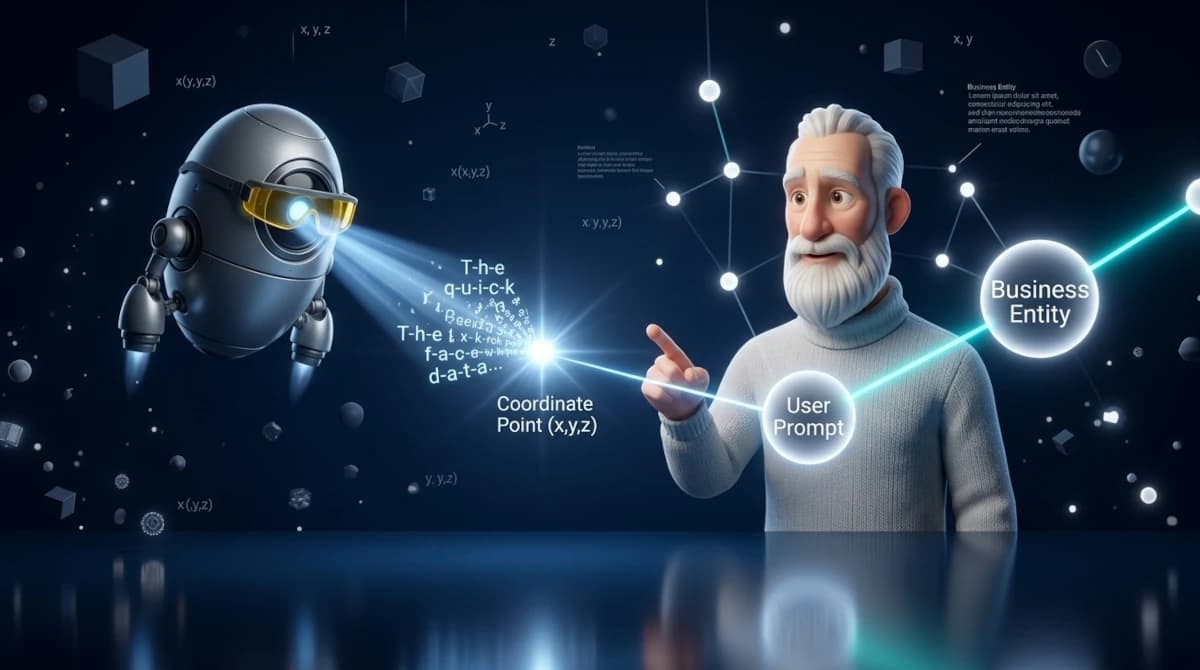
Generative models use dense vector embeddings and Retrieval-Augmented Generation (RAG) to answer user prompts in four distinct stages:
Crawlers slice web copy into 90-token atomic blocks, stripping HTML chrome to focus strictly on factual text.
Bi-encoder neural nets map passage semantics into high-dimensional vector space to calculate prompt cosine similarity.
JSON-LD schema graphs and ABN registry triples confirm brand identity and eliminate hallucination risks.
AI assistants synthesise verified passages into direct recommendations with clickable source citations.
AI Visibility Scan
Test whether conversational search engines extract, verify, and cite your service entity. Enter your domain and core service topic below.
AEObility uses natural language processing (NLP) and Natural Language Web (NLWeb) analysis to evaluate your pages against real conversational search queries. In 45 seconds, you receive a direct on-screen diagnostic covering:
Checks whether machine crawlers can resolve your core business facts, accreditations, and service locations.
Evaluates how cleanly your key answers survive extraction by Retrieval-Augmented Generation (RAG) pipelines.
Identifies whether generative models cite your brand or default to a competitor for your priority topics.
Technical Specifications & Related Modules
Connect your understanding of Answer Engine Optimisation with our technical guides, machine definition triples, and commercial execution sprints:
AEO Services & Digital Infrastructure
Explore our core commercial service offerings, micro-sprint options, and fixed-scope delivery timelines.
AEO Definition & Machine Triple Schema
Review the structured machine-readable triple model linking entity, relationship, and evidence.
AEO Principles & Machine Mechanics
Learn how RAG pipelines, token weight distributions, and positional bias rules shape LLM citation ranking.
Fixed-Scope AEO Micro-Sprints
Rapid 4 to 5 business day implementation sprints addressing structured data, atomic rewrites, and MCP setup.
Frequently Asked Questions
What does AEO stand for in digital marketing?
AEO stands for Answer Engine Optimisation. Unlike traditional SEO which focuses on web page ranking positions in blue-link search results, AEO structures business data for direct passage retrieval across conversational AI surfaces like ChatGPT, Google AI Overviews, Perplexity, and Gemini.
How is AEO different from traditional SEO?
Traditional SEO relies on keyword matching, backlinks, and ranking web page URLs in search engine result pages (SERPs). AEO builds on SEO foundations by formatting content into machine-readable JSON-LD entity graphs, atomic passage blocks, and verified proof triples so AI models can cite your brand.
Why is Answer Engine Optimisation important for Australian businesses?
As buyers increasingly rely on conversational assistants and Google AI features for local service recommendations, businesses without clear machine-readable entity data risk being omitted or misrepresented in AI synthesised answers.
What are the core principles of AEO?
The core principles of AEO include establishing unambiguous brand identity signals (JSON-LD schema), building topical entity authority, structuring content into 90–120 token atomic answer blocks, ensuring multi-platform citation consistency, and verifying claims with evidence triples.
Ready to Close Your AI Visibility Gaps?
Identified missing schema or retrieval gaps during your free scan? Our fixed-scope $995 AEObility Strategic Blueprint delivers a step-by-step technical roadmap, customised entity maps, and direct passage rewrites to get your business recommended across AI search engines and local maps.